.png "Market Overview Header")
.png)
The Florida Office of Insurance Regulation (OIR) oversees one of the most complex property insurance markets in the world and serves as a national leader in identifying market trends and taking bold action to promote a stable and competitive insurance market for consumers.
OIR is a national leader in identifying market trends and taking bold action because OIR collects more data about its insurance market than any other state or regulatory entity. OIR tracks and collects data from different sources to monitor affordability and availability in the property insurance market. A full list of OIR's required data reporting for property and casualty insurers is available here.
This page provides comprehensive data on the homeowners insurance market in Florida and includes data points such as market shares, rates and premiums, company financial information, and reinsurance coverage. This page is intended to serve as a resource for consumers and other stakeholders impacted by Florida's property insurance market.

Property Insurance Market Highlights
Residential Insurance Policies in Force
Admitted Market Avg. Homeowner's Premium (Including Wind)
Admitted Market Avg. Homeowner's Premium (Excluding Wind)
Policies Approved for Citizens Takeout in 2025
30-Day Average Request for Homeowners' Rates
30-Day Average Request for Homeowners' Rates, 1 year ago
180-Day Average Request for Homeowners' Rates
180-Day Average Request for Homeowners' Rates, 1 year ago
Following the passage of historic legislative reform, OIR has greater ability to enforce regulatory authority and has taken actions to increase market regulation compliance. These efforts include, initiating more than 125 market conduct examinations, completing over 745 investigations, and securing over $63.9 million in consumer restitution total since reforms. OIR publishes an Insurer Compliance Report on a quarterly basis to provide ongoing updates on OIR’s market regulation efforts.
Data as of September 2026.
Property Insurance Market Data
Residential Policies and Direct Written Premium
OIR oversees one of the largest insurance markets in the world. One of the way OIR monitors data trends in the property insurance market is by tracking the total number of residential policies, the total direct written premium, and the total insured value within the market.
The table below provides policy totals for all carriers in Florida writing residential policies, including Citizens Property Insurance Corporation, starting with Q2 2023 (April 1 - June 30, 2023) to Q1 2026 (January 1 - March 31, 2026). This data can also be found in OIR's Market Intelligence Reports available here.
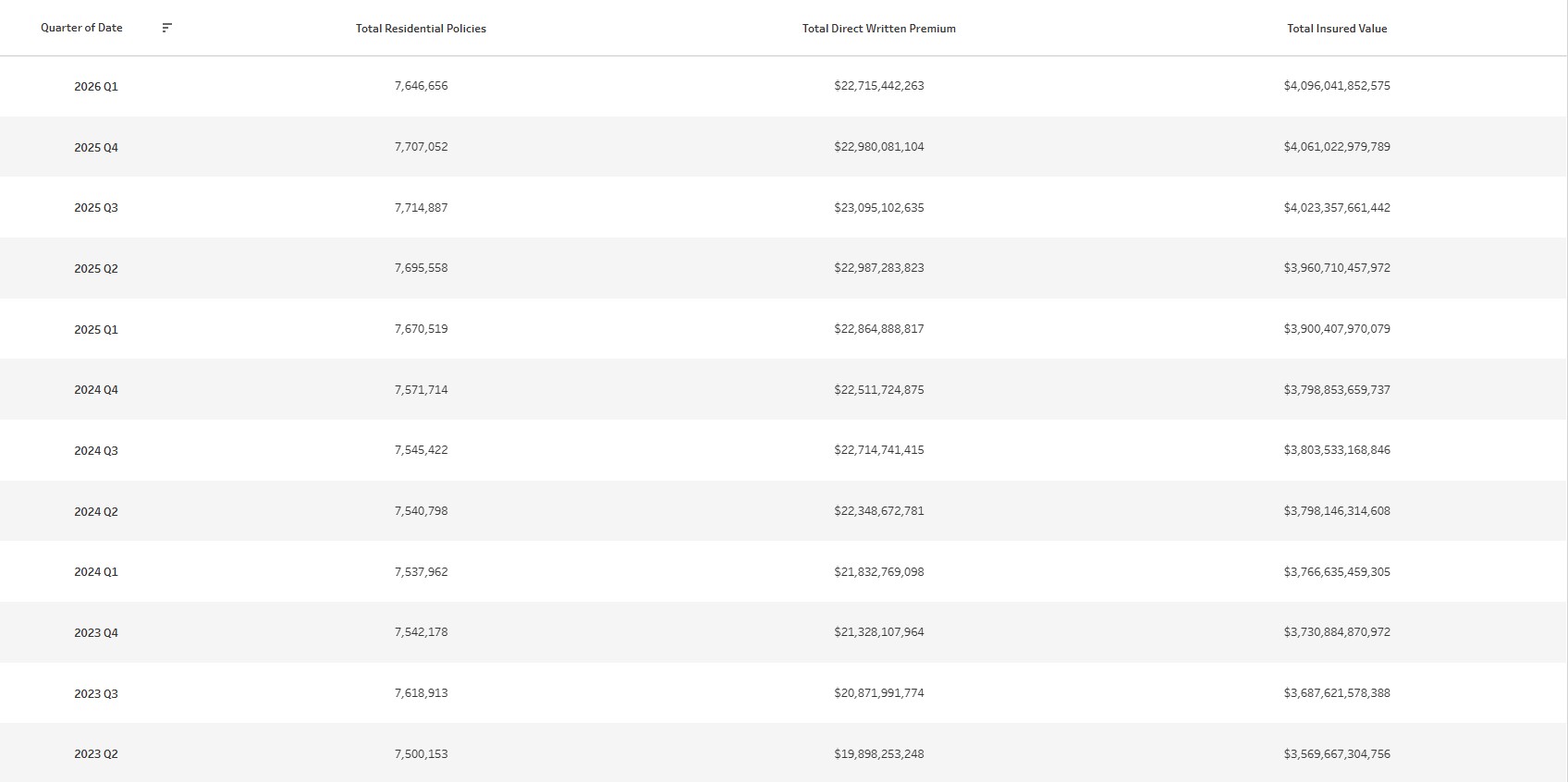
Data as of July 2026. Data from Market Intelligence Reports.
Admitted Property Market vs. Non-Admitted Property Market
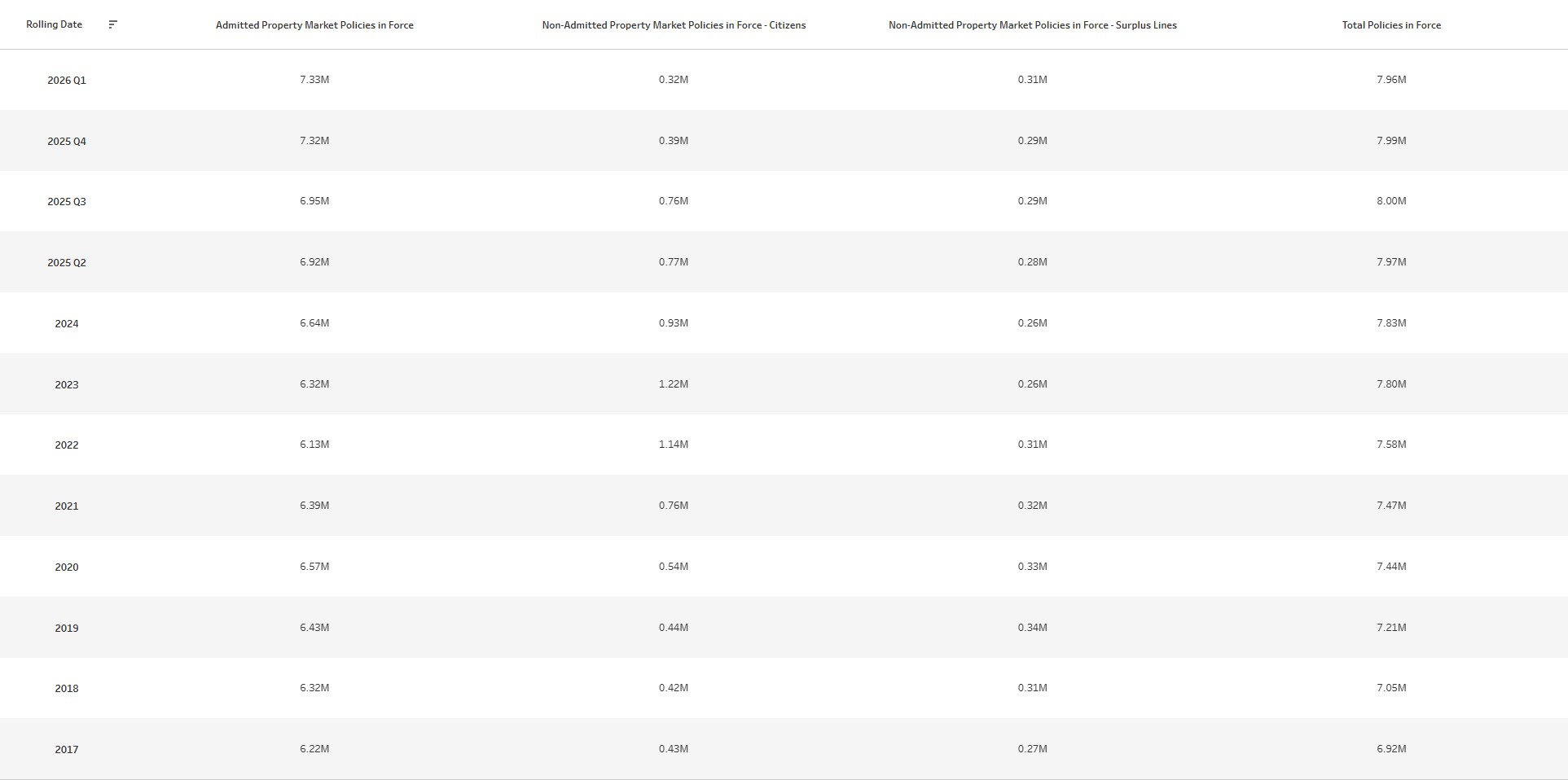
OIR tracks the number of personal and commercial residential property policies within the market through QUASRng. The admitted market is entities regulated through OIR. The non-admitted market is entities such as Citizens Property Insurance Corporation and Surplus Lines carriers. All admitted and non-admitted property writers are required to report data to OIR on a consistent basis. The table and chart below show the percentage of Florida's admitted property insurance market versus the non-admitted property insurance market.
Admitted Property Market vs. Non-Admitted Property Market - Table
Admitted Property Market vs. Non-Admitted Property Market - Chart
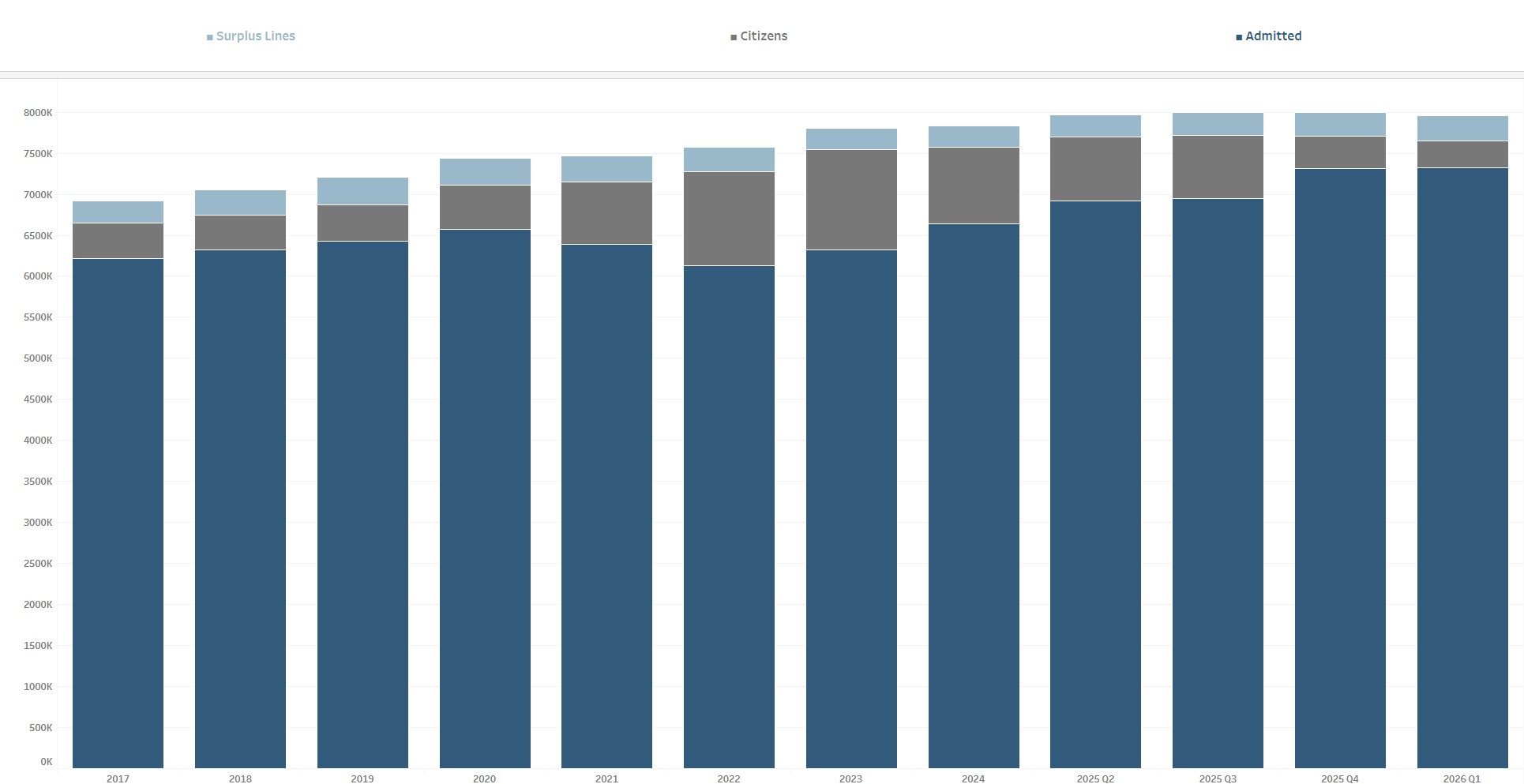 |
Data as of July 2026. Data is from Market Intelligence Report. Data does not include State Farm for years 2017 - 2018 and American Coastal Insurance Company, United Property & Casualty Insurance Company, and Family Security Insurance Company for years 2017 and 2018 due to trade secret declarations.
Residential Market Share Reports
OIR publishes residential market share reports, which provides information about the amount of direct written premium and total exposure by a company within a market. These reports are updated quarterly and are available on OIR's website here.
The table below provides information about statewide totals of property and casualty insurers in Florida as of Q2 2026 (April 1 - June 30, 2026).

Data as of July 2026. Data is from Market Intelligence Report.
The table below provides information about the top 25 largest property and casualty insurers in Florida as of Q2 2026 (April 1- June 30, 2026). Data as of July 2026. Data is from Market Intelligence Report.





Rate and Form Filings
OIR provides the general public with access to thousands of insurance company form and rate filings as part of the "Insurance Regulation Filing System (IRFS) Forms & Rates Filing Search" system. IRFS contains relevant filings for both the Life & Health and Property & Casualty lines of business. Users can search, view and/or download publicly available information related to these types of filings from January 5, 2001 to the present.
Please note, under Florida law, insurers have the option to submit filings as "use and file" or "file and use." A "use and file" filing can be implemented immediately. A company making a "use and file" filing is potentially subject to an order by OIR to return to policyholders portions of rates found to be excessive, in accordance with s. 626.0651, F.S.
The IRFS Forms & Rates Filing Search is available here.
Disclaimer: Displayed rate changes may not fully reflect increases and decreases due to claims of trade secret.
Requested vs Approved Rates - Personal Residential Property
(Homeowners Multi-Peril, Mobile Home Multi-Peril, Dwelling Fire)
Florida's property insurance market has experienced challenges over the past several years. Most of the primary cost drivers in the Florida property insurance market, including catastrophic claims, adverse loss reserve development, inflation, and higher reinsurance costs, are notably exacerbated by excessive and costly litigation. In response to challenges in the market, insurers pass these costs to the consumer by increasing premiums to cover losses and expenses, creating affordability challenges for consumers.
In Florida, there are statutory requirements in place to protect consumers regarding rates and all insurers authorized to transact insurance in Florida must meet all requirements of the Florida Insurance Code. As such, OIR enforces all applicable provisions of Florida Statutes when reviewing policy and rate filings. Rates, including rate increases, must be adequate to maintain insurer solvency and pay claims, in accordance with s. 627.062, F.S. OIR carefully reviews proposed rate filings to ensure they comply with all applicable laws and are not excessive, inadequate, or unfairly discriminatory. Please note, If OIR finds a rate filing is inadequate to support company operations, OIR may direct the company to set a higher rate than requested.
The table below displays the average requested rate for Personal Residential Property lines of business and the average rate approved by OIR for Personal Residential Property lines of business from July 2025 - June 2026.
Personal Residential Property lines of business include Homeowners Multi-Peril, Mobile Home Multi-Peril and Dwelling Fire. Please note, rates for individual policies may vary.
Personal Residential Property Average Rates Requested and Approved - Table
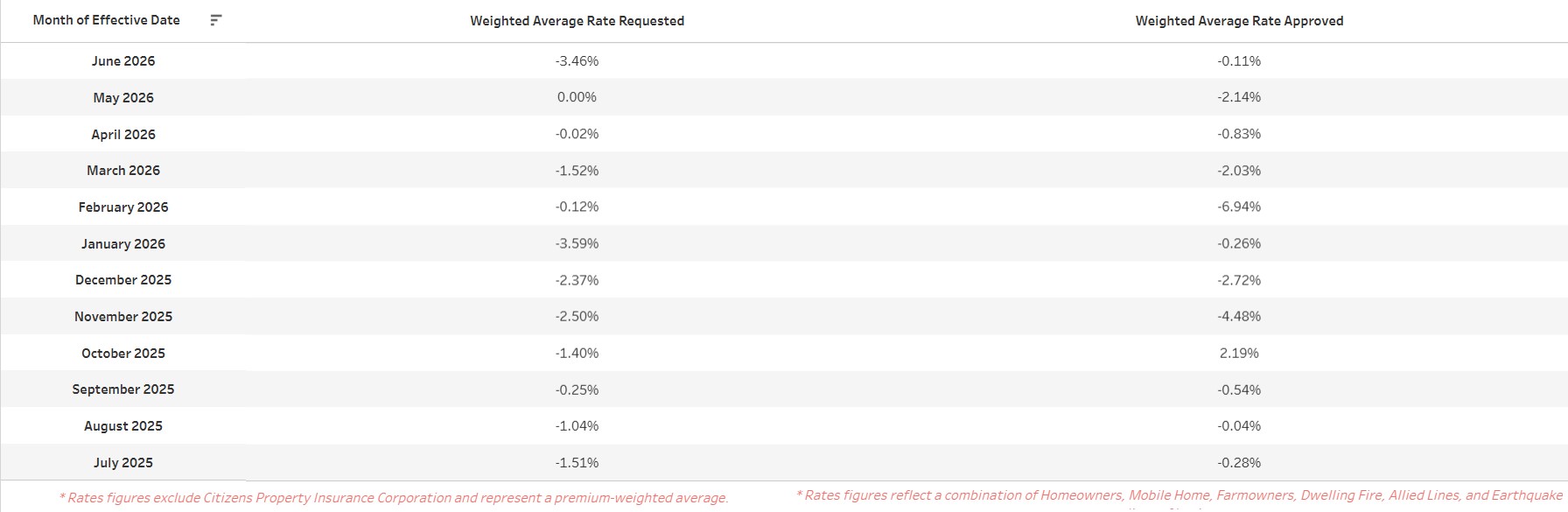
Data as of July 2026 Data is from rate filings submitted by insurers through the Insurance Regulation Filing System. Data excludes Citizens Property Insurance Corporation.
Public Rate Hearings
In Florida, there are statutory requirements in place to protect consumers regarding rates and all insurers authorized to transact insurance in Florida must meet all requirements of the Florida Insurance Code. As such, OIR enforces all applicable provisions of Florida Statutes when reviewing policy and rate filings. Rates, including rate increases, must be adequate to maintain insurer solvency and pay claims, in accordance with s. 627.062, F.S.
OIR carefully reviews proposed rate filings to ensure they comply with all applicable laws and are not excessive, inadequate, or unfairly discriminatory. Additionally, OIR holds rate hearings for rate increases above 15% to receive comments from the public and to hear testimony from companies.
These hearings are open to the public and input from interested parties will be accepted. Those unable to attend the public hearings are welcome to forward comments to OIR at ratehearings@floir.com. The subject line of emails should include the name of the company of interest and the words "rate hearings."
A list of past and upcoming rate hearings can be found on OIR's website here.
Average Homeowners' Policy Premium Data
OIR tracks the average homeowners' policy premium by county. A premium is the amount of money an insurance company charges for insurance coverage. The average premium by OIR is calculated by dividing direct written premium by policies in force.
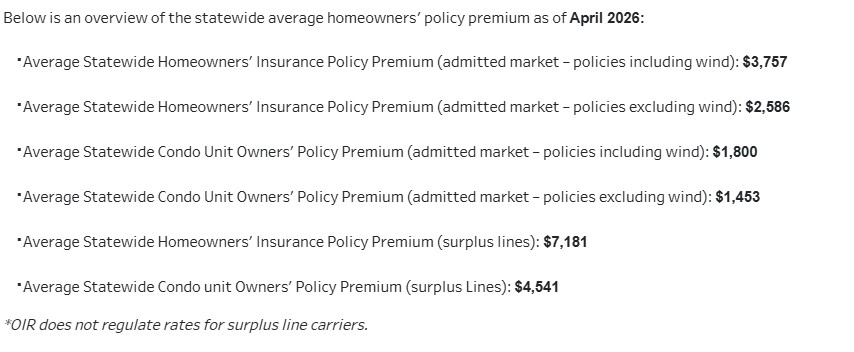
Net Income and Net Underwriting Gain/Loss
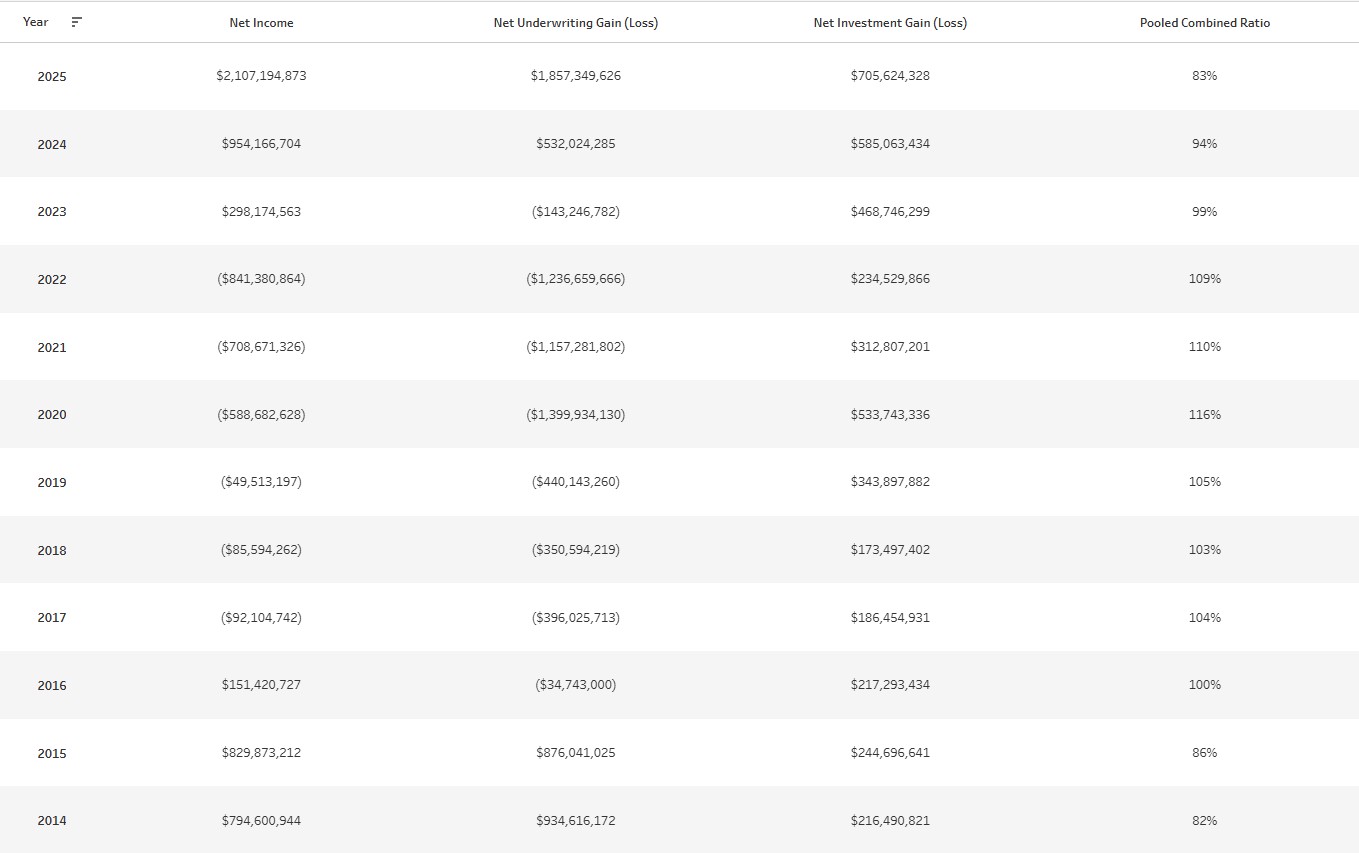
OIR tracks the performance of Florida's domestic property insurers, including net underwriting gains, net income, and average combined ratio. Net Income represents the total revenues from an insurer's operations less total expenses and income taxes. Underwriting Gains or Losses represent how much an insurance company has either made or lost from their operations. The Average Combined Ratio is a measure of profitability which takes the sum of incurred losses and expenses and divides them by earned premium. Generally, an average combined ratio over 100 indicates that a company's profitability was negatively impacted by paying out more in expenses and losses compared to what was received from premium.
Performance of Florida Domestic Property Companies - Table
The table below displays information about the performance of Florida domestic property companies.
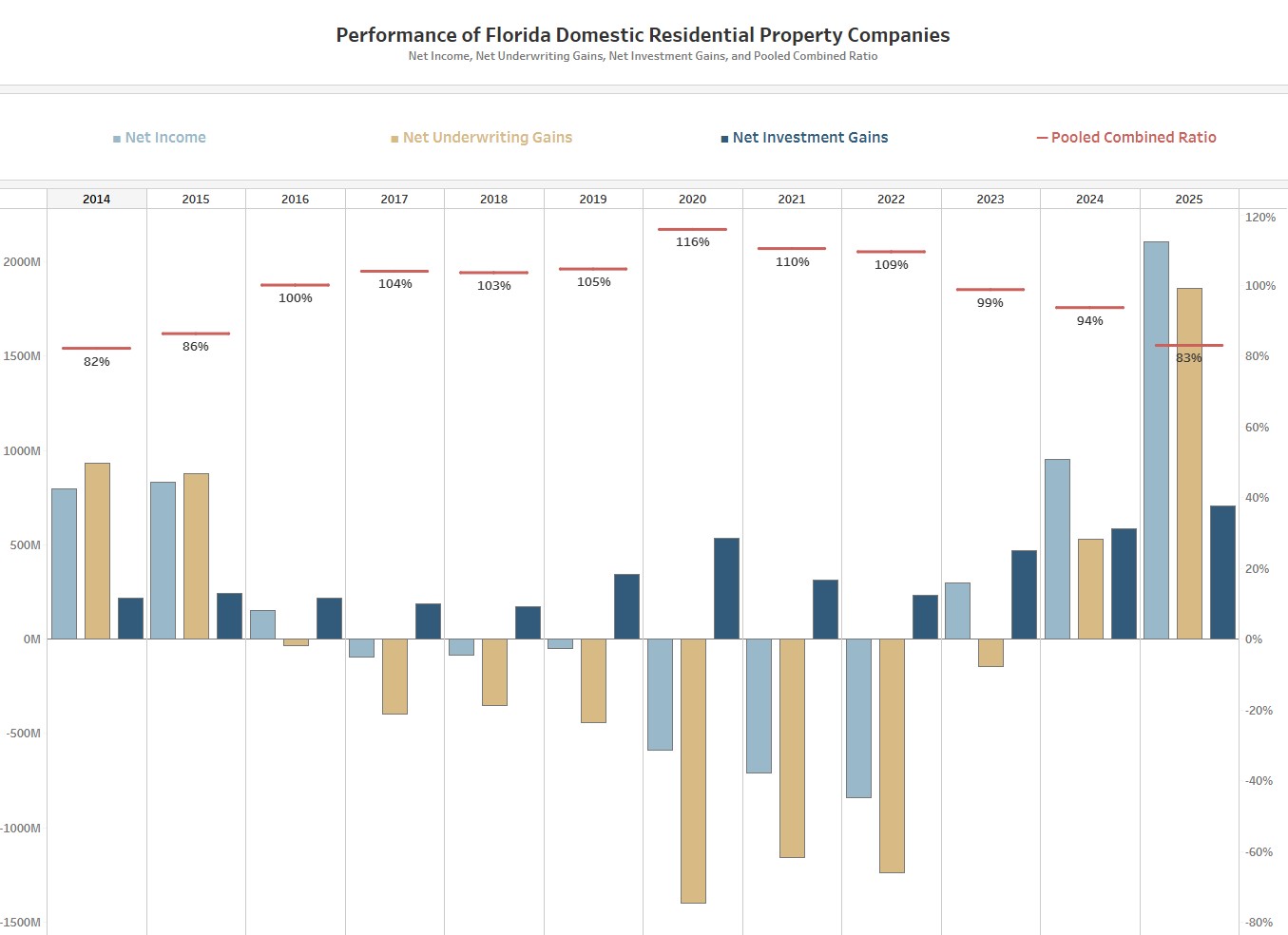
Performance of Florida Domestic Property Companies - Chart
The chart below displays information about the performance of Florida domestic property companies. The orange bar depicts the domestic industry's underwriting gain or loss. The blue bar indicates the domestic industry's net income. The blue line indicates the average combined ratio.
 |
Data as of July 2026. Data is from statutory financial statements submitted to the National Association of Insurance Commissioners. Citizens Property Insurance Corporation data is not included.
Loss Reserve Development
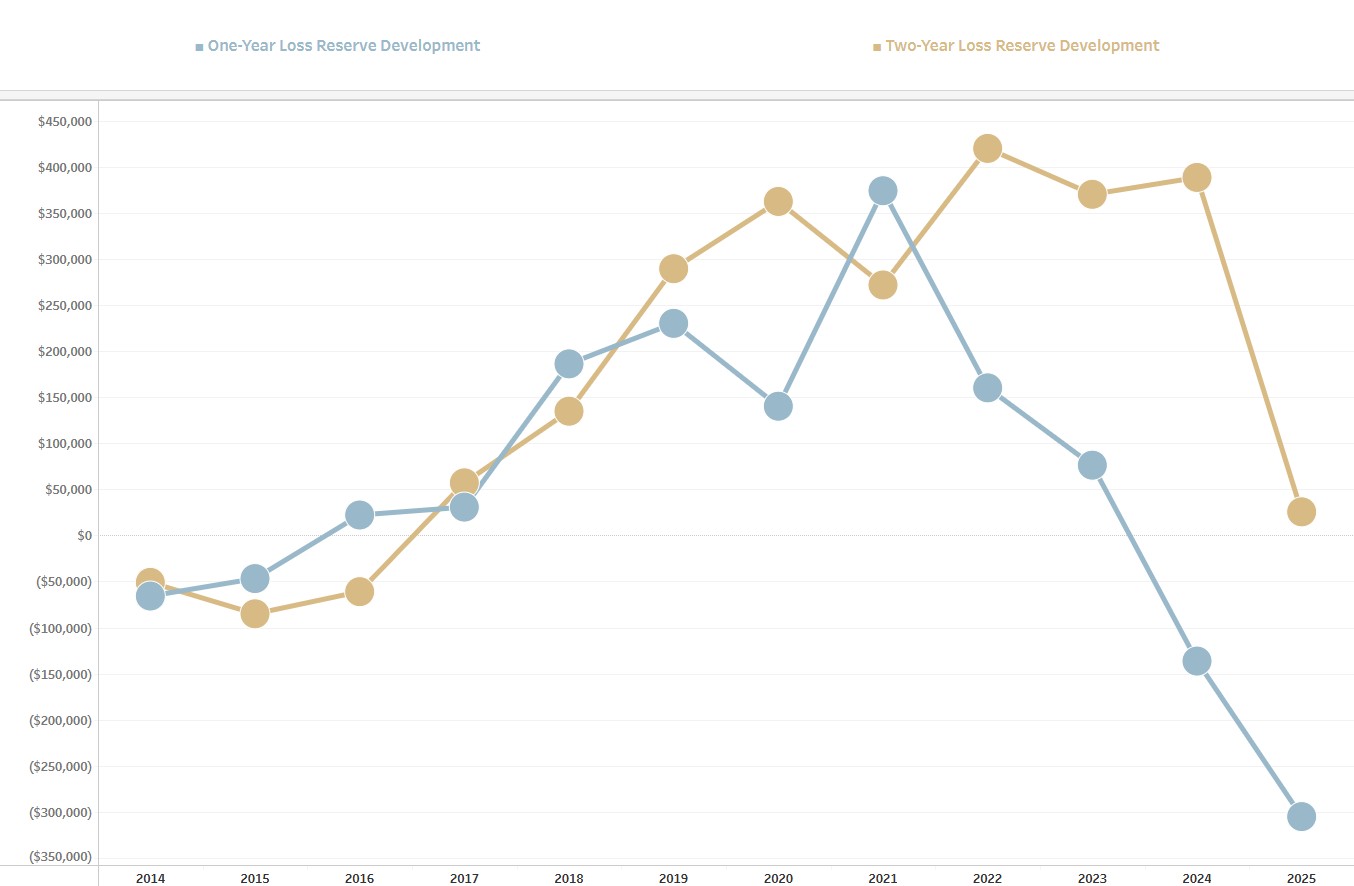
Insurers establish a loss reserve, which is the amount the insurer believes that claims will cost. At periodic points in time, an insurer goes back and evaluates how much those claims actually cost and uses that information to inform reserves going forward. If claims cost less than projected, reserve redundancies exist. If claims cost more than projected, reserves are said to have developed adversely.
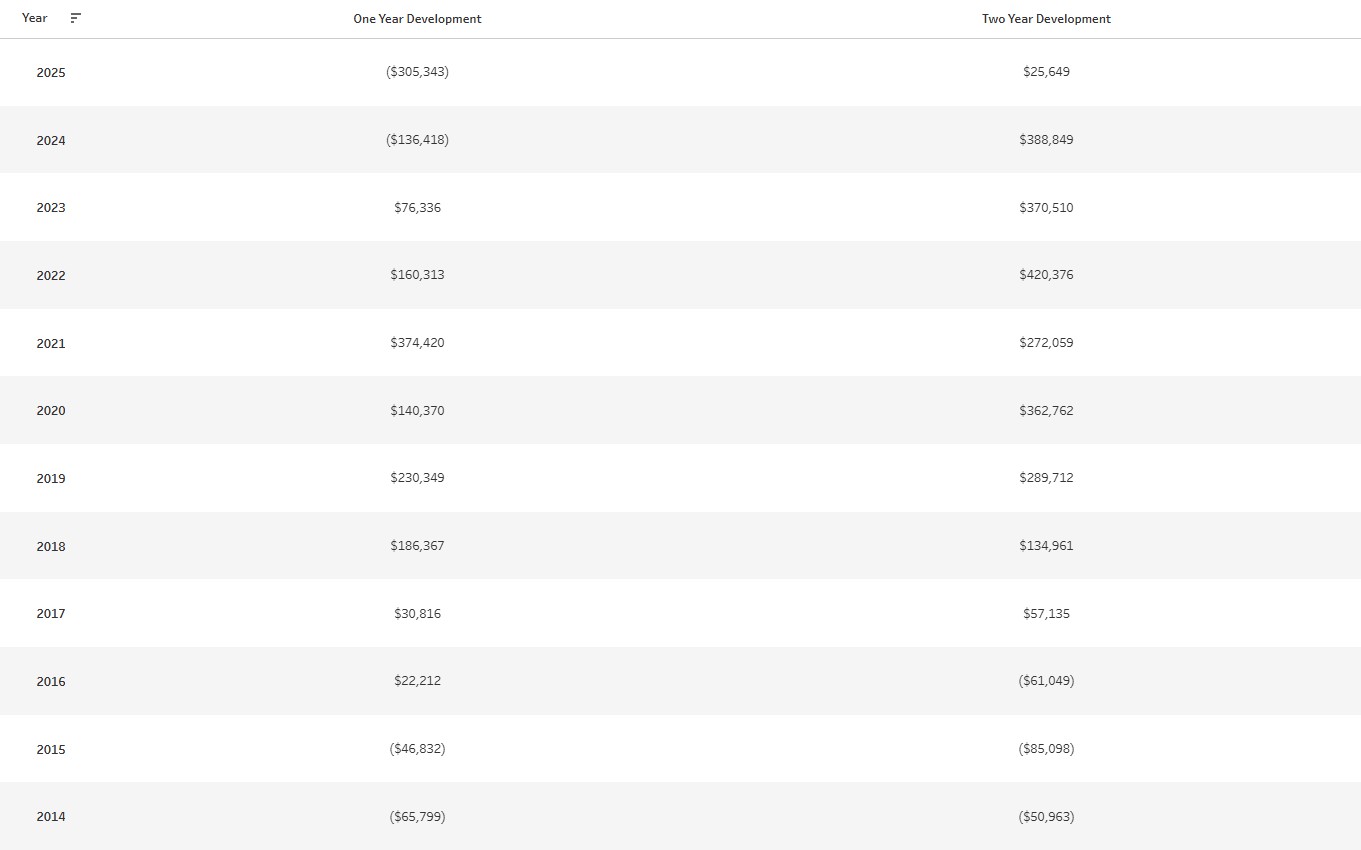
If market trends result in increased claims payments of more than what was originally reserved, the actuary may recommend increasing the company’s reserves for future claims payments. To quantify, when carriers looked back one year later on their claims in 2022, claims were approximately $224 million more than estimated after one year, and $772 million at the two year mark. These numbers reflect the degree of uncertainty which exists in the property insurance market, which in turn impacts reinsurance capacity and reinsurance rates for insurers. The insurance industry is inherently uncertain; for this reason, it is not expected that the established loss reserve will always exactly equal the ultimate cost of claims.
The data in the table and chart below depicts loss reserve development for Florida domestic insurers.
Loss Reserve Development Over Time - Table
Loss Reserve Development Over Time - Chart
For the chart below, the blue line shows the one-year loss reserve development, and the orange line shows the two-year loss reserve development.
 |
Data as of July 2026. Data is from statutory financial statements submitted to the National Association of Insurance Commissioners and from Quarterly Supplemental Reporting. Citizens Property Insurance Corporation is included.
Authorized Insurer Financials
Pursuant to s. 624.315, F.S. OIR tracks the names of authorized insurers transacting insurance in this state, by requiring abstracts of their financial statements including assets, liabilities, and net worth. The documents below contain the Authorized Florida Insurer Financial Abstracts for calendar years 2019, 2020, 2021 and 2022, as required by s. 624.315, F.S.. The Authorized Florida Insurer Financial Abstracts contain information regarding net admitted assets, liabilities, capital and surplus, and direct premiums written in Florida.
Please note: Data represented in the Authorized Florida Insurer Financial Abstracts is submitted to OIR following the conclusion of the previous calendar year. Each report below is categorized by publishing year and the calendar year data contained within the report.
- 2023 Report - Calendar Year 2022
- 2022 Report - Calendar Year 2021
- 2021 Report - Calendar Year 2020
- 2020 Report - Calendar Year 2019
Florida Public Hurricane Loss Model
Florida leads the nation in a number of ways, including its longstanding focus on comprehensive efforts to protect the insurance market. This includes innovative insurer solutions of how to apply technology and innovation to the mitigation of storm, wildfire, and other risks; evaluation of insurance product innovation directed at reducing, managing, and mitigating risk, as well as closing protection gaps; considering pre-disaster mitigation and resiliency in the role of state insurance regulators; and engaging with ongoing mitigation research and analysis.
One of the tools OIR uses to protect the insurance market is the Florida Public Hurricane Loss Model (FPHLM). The FPHLM is a hurricane catastrophe model developed by a multi-disciplinary team of experts in the fields of meteorology, wind and structural engineering, computer science, GIS, statistics, finance, and actuarial science.
The model consists of three major components: wind hazard (meteorology), vulnerability (engineering), and insured loss cost (actuarial). It has over a dozen sub-components. The computer platform is designed to accommodate future hookups of additional sub-components or enhancements.
The FPHLM estimates loss costs and probable maximum loss levels from hurricane events for personal lines and commercial lines of residential property. The losses are estimated for building, appurtenant structure, contents, and additional living expenses.
In essence the FPHLM, unique to Florida, is a complex collection of computer programs that simulate and predict how, where and when hurricanes form, their wind speeds, intensity and sizes, their tracks, how they are affected by the terrain after landfall, how the winds interact with different types of structures, how much damage they can cause to house roofs, windows, doors, and interiors, how much it will cost to rebuild the damaged parts, and how much of the loss will be paid by insurers. More information on the FPHLM is available here.
The OIR utilizes the FPHLM as a tool for benchmarking rate filing requests submitted by Florida insurers to assist with evaluating the reasonableness of the modeling information provided and the associated rate request.
The FPHLM plays a significant role within OIR’s Catastrophe Stress Test (CST). While insurers elect models to utilize within their CST, FPHLM accommodates OIR’s analysis of the CST by providing insurers’ modeled loss outputs computed by the FPHLM. The varying outputs populated from multiple models provide OIR with an array of probabilities and further understanding of insurers’ ability to place adequate reinsurance programs and sustain financial solvency following payment of losses. More information regarding the CST is provided below.
Annual Reinsurance Data Call
Florida is the most catastrophe-prone state in the United States with 8,436 miles of shoreline. To spread that catastrophic risk outside of Florida’s borders, insurers turn to the global reinsurance market. Florida’s domestic property insurance industry is especially reliant on reinsurance to finance the payment of catastrophe losses and is sensitive to hardening reinsurance market conditions. When the supply of reinsurance is readily available and affordable, the capacity of domestic property insurers to write and retain business is enhanced, and the premium impact to consumers is modest.
OIR conducts the ARDC to assess insurers’ financial viability in covering catastrophic losses with respect to their catastrophic reinsurance programs. The ARDC consists of four stages:
• Stage 1 – Collect estimate of what insurers plan to purchase for reinsurance.
• Stage 2 – Collect the actual amount of reinsurance purchased by insurers.
• Stage 3 – Collect information on participating reinsurers and reinsurance contracts placed.
• Stage 4 – Collect data reporting the impact of storms on insurers’ reinsurance contracts.
Preliminary 2026 ARDC data suggests nearly half of ARDC insurers are experiencing risk-adjusted pricing reductions between 15% and 25%. Initial data signifies a favorable reinsurance market with abundant reinsurer capital, healthy competition between traditional and alternative reinsurance markets, and improved terms and conditions.
Citizens Property Insurance Corporation Proposed Rate Level Effect - 2025
The proposed 2025 Citizens Rate Filings listed below can be accessed via the IRFS Forms & Rates Filing Search system by searching the file log number or by entering "Citizens" as the "company name" in the "Quick Search" tab. Additional information regarding the proposed 2025 Citizens Rate Filings is available in the Citizens 2025 Rate Media Kit here.
| File Log # | Overall Proposed Change | Account | Proposed Rate Level Effect by Territory and County |
| 24-030310 | +13.5% | Homeowners Multi-Peril (PLA) | HO-3, HO-4, HO-6 (PLA) |
| 24-030311 | +14.4% | Homeowners Multi-Peril (CA) | HO-3, HO-4, HO-6 (CA) |
| 24-030441 | +13.9% | Property/Personal (Dwelling Fire) (PLA) | DP-1, DP-3 (PLA) |
| 24-030444 | +17.2% | Property/Personal (Dwelling Fire) Wind Only (CA) | DW-3 (CA) |
| 24-031016 | +22.1% | Mobile Homeowners Multi-Peril (PLA) | MHO-3, MHO-4 (PLA) |
| 24-031018 | +26.6% | Mobile Homeowners Multi-Peril (CA) | MHO-3 (CA) |
| 24-031814 | +19.0% | Mobile Homeowners Physical Damage (PLA) | MHO-Dwelling (PLA) |
| 24-031855 | +19.7% | Mobile Homeowners Physical Damage Wind Only (CA) | MHO-Dwelling (CA) |
| 24-037241 | +12.0% | Commercial Residential Multi-Peril Condo Assn. (CLA) | CRM Condo (CLA) |
| 24-037237 | +11.5% | Commercial Residential Multi-Peril Excluding Condo Assn. (CLA) | CRM Non-Condo (CLA) |
| 24-037430 | +0.0% | Commercial Non-Residential Multi-Peril (CLA) | CNRM (CA) |
| 24-037523 | +12.2% | Commercial Residential Wind Only Excluding Condo (CA) | CRW Non-Condo (CA) |
| 24-037522 | +12.4% | Commercial Residential Wind Only Condo Assn. (CA) | CRW Condo (CA) |
| 24-037525 | +0.4% | Commercial Non-Residential Wind Only (CA) | CNRW (CA) |
Citizens Property Insurance Corporation - 2024 Public Rate Hearing
OIR conducts an annual public rate hearing for proposed Citizens Property Insurance Corporation rate filings to hear testimony from the company and receive public comment. These hearings are open to the public and input from interested parties will be accepted. Those unable to attend the public hearings are welcome to forward comments to OIR by emailing ratehearings@floir.com with the subject line "Citizens Property Insurance Corporation." Please note, under Florida law, written communications to OIR are public record and subject to disclosure, including being available to the public and media.
Details for the 2024 Citizens Property Insurance Corporation Public Rate Hearing are below:
| When | Where | General Subject Matter to be Considered | Additional Materials |
August 1, 2024 1 p.m. | 412K Knott Building, Tallahassee, FL 32399 Click here to register and participate online. By Phone: 1-877-568-4108; Access Code: 768-800-634 | Citizens Property Insurance Corporation has requested statewide average rate change for its business in the Coastal Account ("CA"), Commercial Lines ("CLA"), and Personal Lines Account ("PLA"). |
Information for previous Citizens Property Insurance Corporation rate hearings are below:
Citizens Property Insurance Corporation Depopulation/Takeout Program
Takeout, or depopulation, is the program created by the Florida Legislature that was developed to reduce the number of Citizens’ insured properties and exposure. The program, created by section 627.351(6)(q), F.S., allows new and existing insurance companies to assume policies currently covered by Citizens in an attempt to transfer policies back to the private insurance market.
To assume policies from Citizens, private-market insurance companies must submit documentation to OIR verifying they meet OIR standards and have the financial resources and business plan in place to properly pay claims. If approved, OIR will issue a consent order indicating the number of policies eligible for removal, the assumption date and any additional stipulations.
As the property market continues to stabilize, OIR is seeing a continued interest from authorized insurers in the Citizens Depopulation program. OIR's Takeout Assumption Summaries, Takeout Company Approvals, and Requirements to Participate in the Takeout Program is available on OIR's website here.
The table below information about companies approved for the takeout program, number of policies approved for assumption, number of policies removed from Citizens, and the total reduced Citizens exposure from 2019 - 2024.
| Year | Total Companies Approved for Takeout | Total Policies Approved for Assumption | Total Policies Removed from Citizens** | Reduced Citizens Exposure** |
| 2024* | 18 | 1,263,749 | 371,295 | $170,384,224,633 |
| 2023 | 12 | 646,617 | 275,324 | $113,375,478,857 |
| 2022 | 4 | 80,201 | 16,408 | $7,173,925,259 |
| 2021 | 1 | 17,208 | 2,814 | $1,027,251,879 |
| 2020 | 4 | 87,288 | 7,463 | $2,497,401,410 |
| 2019 | 4 | 145,102 | 10,084 | $2,180,766,592 |
*Calendar Year 2024 data as of 9/05/2024.
**Data provided from Citizens Depopulation Resources page. Data as of 10/29/2024.
.png "Section Header_Fort")
Data Reporting & Collection
OIR collects data from insurers and regulated entities in accordance with Florida Statues. A full list of required data reporting is available on OIR's website here. A list of required data call reporting specific to property and casualty insurers is below:
- Temporary Discontinuance of Writing New Residential Property Insurance Policies - In accordance with Section 624.4301, Florida Statutes, and Rule 69O-137.014, Florida Administrative Code, any authorized insurer, before temporarily suspending writing new residential property insurance policies in Florida, must give notice to OIR.
- Commercial and Personal Residential Property Supplemental Quarterly Report - In accordance with section 624.424(10), Florida Statutes, insurers are required to report QUASR data to OIR on a quarterly basis.
- Catastrophe Claims Reporting - In accordance with section 624.307, Florida Statutes, OIR can institute a data call for the purpose of collecting additional claims and other relevant information from insurers related to a natural disaster causing catastrophic damage in Florida.
- P&C Calendar Year Experience Reporting - In accordance with section 627.915(2) and 627.915(5), Florida Statutes, companies are required to report PCCY Experience Reporting data to OIR on an annual basis. For PCCY Experience Reporting, insurers provide information on: Direct Premiums Written; Direct Premiums Earned; Loss Reserves for All Known Claims; Reserves for Losses Incurred but not Reported; Allocated Loss Adjustment Expense; Unallocated Loss Adjustment Expense; Direct Losses Paid; Underwriting Income or Loss; Commissions and Brokerage Fees; Taxes, Licenses and Fees; Other Acquisition Costs; General Expenses; Policyholder Dividends; Net Investment Gain or Loss.
- Residential Property Claims Litigation Reporting - In accordance with s. 624.424(11), F.S., companies are required to report personal and commercial residential property claims litigation data to OIR on an annual basis. This data call details the closed claim experience for the previous calendar year.
Historic Legislative Reform
Florida has enacted historic and unprecedented reforms designed to promote market stability. OIR closely tracks the impact of legislation on Florida's property insurance market. As we begin to see the impacts from these reforms, OIR remains committed to working alongside Governor DeSantis, the Florida Cabinet and the Florida Legislature to promote a stable and competitive insurance market for consumers.
For a full overview of insurance legislation passed by the Florida Legislature, please see OIR's Legislative Summaries here. Recent legislative reforms for Florida's property insurance market include:
- 2024: HB 1611 (Insurance), HB 1049 (Flood Disclosure in the Sale of Real Property), SB 7028 (My Safe Florida Home Program), HB 1029 (My Safe Florida Home Condominium Pilot Program)
- 2023: HB 799 (Property Insurance), HB 881 (My Safe Florida Home Program), HB 1185 (Consumer Protection), HB 837 (Civil Remedies), SB 7052 (Insurer Accountability)
- 2022: SB 2A (Dec. 2022 Special Session), SB 2D (May 2022 Special Session), SB 4D (May 2022 Special Session)
- 2021: SB 76 (Property Insurance), SB 1598 (Consumer Protection)
- 2020: HB 529 (Insurance Guaranty Associations)
- 2019: HB 7065 (Insurance Assignment Agreements)
Following these historic legislative reforms to strengthen Florida’s insurance market, OIR has approved twenty-one additional property & casualty insurers to enter Florida’s market. Recently approved companies:
Sypher Insurance Exchange
Builder Reciprocal Insurance Exchange
Frontline Insurance Reciprocal Exchange
Wingsail Insurance Company
Stand Insurance Exhange
Praxis Reciprocal Exchange
Viceroy Preferred Insurance Company
Florida Insurance and Reinsurance Company
Incline National Insurance Company
Apex Star Reciprocal Exchange
Mangrove Property Insurance Company
ASI Select Insurance Corp.
Trident Reciprocal Exchange
Ovation Home Insurance Exchange
Manatee Insurance Exchange
Condo Owners Reciprocal Exchange
Orange Insurance Exchange
Orion180 Select Insurance Company
Orion180 Insurance Company
Mainsail Insurance Company
Tailrow Insurance Exchange
.png "Section Header_Keys")
- June 13, 2024 - Governor Ron DeSantis’ FY 2024 – 2025 Focus on Florida’s Future Budget Ensures Consumer Protection and Fosters a Competitive Insurance Market
- May 17, 2024 - May 2024 Florida Property Insurance Market Update Document
- May 17, 2024 - OIR Provides Update on Florida's Strengthening Property Insurance Market
- April 3, 2024 - OIR Issues Update on Florida's Property Insurance Market
- January 5, 2024 - OIR Approves the Direct Acquisition of Trusted Resource Underwriters Exchange, Resulting in $1.25 Billion Capital Investment into Florida’s Insurance Market
- December 29, 2023 - Florida Insurance Commissioner Michael Yaworsky Highlights Efforts to Promote a Stable and Competitive Insurance Market During 2023
- November 21, 2023 - OIR Approves New Application to Form a Domestic Property Reciprocal Insurer
- August 22, 2023 - OIR Approves Two Companies to Form as Property and Casualty Insurers in Florida Following Legislative Reforms
- August 14, 2023 - Florida’s Insurance Market Continues Growth Following Historic Reforms to Property & Casualty Market
- April 18, 2023 - OIR Approves Application to Form as an Authorized Domestic Insurer, Increasing Options for Consumers in Florida’s Property and Casualty Insurance Market
- QUASR - Additional data regarding policies in Florida is available in QUASR. The QUASR database will allow you to run reports for policies in force by quarter, by county, by policy type and by company for companies writing in Florida. Please note, data for companies filing Trade Secret will not appear within the database or the top 25 reports linked. The list of companies filing Trade Secret is available on the OIR website, including the date for which they began filing as trade secret.
- Insurer Stability Unit Report - OIR publishes the Insurer Stability Report on January 1 and July 31. The report contains information about the stability of property and casualty insurers and offers information about average insurance premiums by county. All Insurer Stability Unit reports are available on OIR's Industry Reports page under "Property Insurance Stability Report."
- Insurer Compliance Report - OIR is required to publish a quarterly insurer compliance report. This report details all market regulation actions OIR took for the previous quarter. All Insurer Compliance reports are available on OIR's Industry Reports page under "Insurer Compliance."
- New Entities in the Market - OIR publishes a monthly list of all new regulated entities approved to enter Florida's insurance market.
- Orders and Memoranda - This page contains information on all Consent Orders and Informational Memoranda issued by OIR.
- OIR's Property & Casualty Market Regulation - The Property and Casualty Market Regulation unit conducts examinations and investigations of property and casualty insurers and related parties regarding business practices and patterns of alleged violations of the Florida Insurance Code. The unit also investigates allegations of unauthorized and illegal insurance activity as well as in-depth investigations of authorized insurers.
- OIR's Property & Casualty Financial Oversight - The Property and Casualty Financial Oversight Unit is responsible for monitoring the financial condition of property and casualty, title insurers and self-insurance funds by conducting financial examinations and ongoing financial analysis.
- Catastrophe Claims Data and Reporting - OIR collects catastrophe claims data following a disaster, such as a hurricane. Catastrophe claims data for recent disasters is available on this page.
- Active Company Search - OIR's company search service can provide full names, business addresses, and identifying information for companies/entities doing business in the State of Florida.
- CHOICES Rate Comparison Tool - OIR offers the CHOICES rate comparison tool to provide consumers with rate information for various types of insurance. The CHOICES tools for auto and homeowners insurance are based on three pre-defined model risk scenarios to provide the consumer with sample average rates in any Florida county.
- OIR Hurricane Season Resources - OIR offers resources to help consumers prepare for severe weather.
- My Safe Florida Home Program - The My Safe Florida Home Program provides grants to Florida homeowners for mitigating their homes against disaster impacts.
- Department of Financial Services' Division of Consumer Services - To file a complaint against an insurance company, contact the Department of Financial Services' Division of Consumer Services.
- NAIC Consumer Database - The National Association of Insurance Commissioners (NAIC) offers a consumer database which allows individuals to look up company complaint and financial information by state and insurance type.